
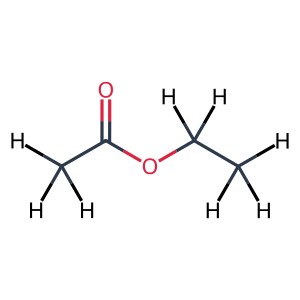
Ethylacetate
ethyl aceate | ETHYL ACETATE [FCC] | Ethyle(acetate d') | acetic acid ethyl | acetic ethyl ester | DTXSID1022001 | Etile (acetato di) [Italian] | ETHYL ACETATE (EP MONOGRAPH) | Ethyl acetate (natural) | CH3COOC2H5 | ethy acetate | Ethyl acetate [NF] | ETH
CAS141-78-6
Molecular formulaC4H8O2
Molar mass88.11 g/mol
Hazardous
Physical Description | Ethyl acetate appears as a clear colorless liquid with a fruity odor. Flash point 24 °F. Less dense than water. Vapors heavier than air.
Scientific Grain Officer - Dictionary Editorial Department, revised at:2026-10-19
Toxicity
ToxicityBody Burden
Mother's milk from 4 urban areas in the USA, 1 of 8 samples tested positive for ethyl acetate(1). 7 out of 12 breath samples collected from nine volunteers in Bayonne and Elizabeth, NJ between July and Dec 1980 contained ethyl acetate at unreported concentrations(2). Ethyl acetate was identified as a component in 13.7% of expired air samples from 54 volunteers in the Chicago area at a geometric mean concentration of 0.447 ng/L(3). Ethyl acetate was detected in expired air samples from 5 of 8 male volunteers at levels ranging from 0.30 to 190.0 ug/hr(4). Five out of 8 personal air samples collected from volunteers in Bayonne and Elizabeth, NJ between July and Dec 1980 contained ethyl acetate at unreported concentrations(5).
Fate Summary
ATMOSPHERIC FATE: According to a model of gas/particle partitioning of semivolatile organic compounds in the atmosphere(1), ethyl acetate, which has a vapor pressure of 93.2 mm Hg at 25 °C(2), is expected to exist solely as a vapor in the ambient atmosphere. Vapor-phase ethyl acetate is degraded in the atmosphere by reaction with photochemically-produced hydroxyl radicals(SRC); the half-life for this reaction in air is estimated to be 9 days(SRC), calculated from its rate constant of 1.6X10⁻¹² cu cm/molecule-sec at 25 °C(3). Ethyl acetate does not contain chromophores that absorb at wavelengths >290 nm(4) and, therefore, is not expected to be susceptible to direct photolysis by sunlight(SRC).
Soil Adsorption / Mobility
The Koc of ethyl acetate is estimated as 18(SRC), using a log Kow of 0.73(1) and a regression-derived equation(2). According to a classification scheme(3), this estimated Koc value suggests that ethyl acetate is expected to have very high mobility in soil(SRC). A log Ki (snow surface/air (cu m/sq m)) of -3.69 has been reported for sorption to snow(4).
Environmental Biodegradation
ANAEROBIC: Ethyl acetate has been demonstrated to be amenable to anaerobic biodegradation(1). It was mineralized (>75% of theoretical methane production) in 10% sludge from a secondary digester within 8 weeks(2). 96% utilization occurred in an anaerobic reactor with a 20 day retention time(3). Ethyl acetate, at a concentration of 1000 mg/L, was readily degraded in batch reactors containing anaerobic solids from an industrial anaerobic digester with some exposure to ethyl acetate(4). 100% loss of ethyl acetate was observed in aquifer slurries amended with sulfate and nitrate following 244 days and 85 days incubation, respectively(5). 94% of theoretical methane production was observed after incubation in sediment and groundwater collected from the methanogenic portion of an anoxic aquifer...
Environmental Bioconcentration
An estimated BCF of 3 was calculated for ethyl acetate(SRC), using a log Kow of 0.73(1) and a regression-derived equation(2). According to a classification scheme(3), this BCF suggests the potential for bioconcentration in aquatic organisms is low(SRC).
Volatilization from Water / Soil
The Henry's Law constant for ethyl acetate is 1.34X10⁻⁴ atm-cu m/mole(1). This Henry's Law constant indicates that ethyl acetate is expected to volatilize from water surfaces(2). Based on this Henry's Law constant, the volatilization half-life from a model river (1 m deep, flowing 1 m/sec, wind velocity of 3 m/sec)(3) is estimated as 9 hours(SRC). The volatilization half-life from a model lake (1 m deep, flowing 0.05 m/sec, wind velocity of 0.5 m/sec)(3) is estimated as 6 days(SRC). Ethyl acetate's Henry's Law constant indicates that volatilization from moist soil surfaces may occur(SRC). Ethyl acetate is expected to volatilize from dry soil surfaces(SRC) based upon a vapor pressure of 93.2 mm Hg(3).
Environmental Abiotic Degradation
The rate constant for the vapor-phase reaction of ethyl acetate with photochemically-produced hydroxyl radicals is 1.60X10⁻¹² cu cm/molecule-sec at 25 °C(1). This corresponds to an atmospheric half-life of about 9 days at an atmospheric concentration of 5X10+5 hydroxyl radicals per cu cm(2). A base-catalyzed second-order hydrolysis rate constant of 0.12 L/mole-sec(SRC) was estimated using a structure estimation method(2); this corresponds to half-lives of 1.8 years and 66 days at pH values of 7 and 8, respectively(3). The observed rate constant for the vapor-phase reaction of ethyl acetate with nitrate radicals is 1.4X10¹⁷ cu cm/molecule-sec(3,4). This corresponds to an atmospheric half-life of about 16 years(SRC) at an average night-time nitrate radical concentration of 2X10+8 molecule...
Environmental Water Concentrations
SURFACE WATER: Of 14 heavily industrialized river basins in USA (204 sites), only 1 site (Delaware River Basin) tested positive for ethyl acetate, at 1 ppb(1). The concentration in the Hayashida River in Tatsumo City, Japan (site of leather industry) was reported at 585 ppb(2). Ethyl acetate was identified in water samples from the brook, Rickenbach East, Switzerland, which receives discharges from a paint factory(3).
Food Survey Values
Ethyl acetate was detected, not quantified as a flavor volatile of Korean red pine (Pinus densiflora) sprout tea and pine needle tea; needles were collected in May to June 1995(1). It is a volatile constituent from the leaves of Callicarpa japonica Thunb. /Japanese beautyberry/, a member of the Verbenaceae family native to Korea, Japan, China and Taiwan(2).
Milk Concentrations
Mother's milk from 4 urban areas in the USA, 1 of 8 samples positive(1).
Ecotoxicity Excerpts
/AQUATIC SPECIES/ Exposure of the fish /common Indian catfish, Heteropneustes fossilus/ to 170 ppm of ethyl acetate for 3, 6, 12, 48, and 96 hr induced marked changes in carbohydrate metabolism. Hepatic glycogen levels declined significantly at 3, 48, and 96 hr, but there was no marked alteration in muscle glycogen content at any of the exposure periods. Hyperglycemia occurred at all time intervals. Blood pyruvate levels were elevated at 3, 6, 48, and 96 hr. Hyperlacticemia resulted at 3 and 96 hr, but hypolacticemia occurred at 6 and 12 hr. Impairment of carbohydrate metabolism might be responsible for the toxic action of ethyl acetate.
Plant Concentrations
Ethyl acetate was identified as a volatile component of kiwi fruit flowers(1). Volatile emissions from Scots pine were found to contain ethyl acetate(2).
Effluent Concentrations
Ethyl acetate was detected, not quantified in oil refinery final effluent(1) and effluent from sewage treatment plants(2). Ethyl acetate has been detected in U.S. municipal landfill leachate at concentrations ranging from 42 to 290 g/L(3). Ethyl acetate was identified, but not quantified, in hazardous waste samples from a Midwest remedial action site(4). Ethyl acetate was detected, but not quantified, in a grab sample of oil refinery final effluent from a refinery in Lockport, IL(5). Ethyl acetate was identified as a volatile organic compound in a composite waste sample obtained from a barge which dumped its waste on Feb 9, 1978 at the Puerto Rico dumpsite(6). Ethyl acetate was identified in flue gas from a waste incineration plant in Germany(7).
Natural Pollution Sources
Ethyl acetate is a natural product of fermentation(1,2). Natural sources of ethyl acetate include animal waste, plant volatiles, and microbes(1). Ethyl acetate occurs naturally in yeast and sugarcane, where it is photosynthetically produced. It is also released by molds(3).
Atmospheric Concentrations
SOURCE DOMINATED: Ethyl acetate was detected in ambient air surrounding Kin Buc waste disposal site (4 sites) 0, trace, 4.1, 230 ug/cu m(1). Ethyl acetate was detected in ambient air near a furnace used for incinerating paint wastes at a concentration of 0.7 ppbv(2).
Fish/Seafood Concentrations
Ethyl acetate was identified in a sample of mussel collected from the Oarai Coast in Ibaraki, Japan on July 31, 1985 at a concentration of 97.1 ug/g(1).
Artificial Pollution Sources
Ethyl acetate's production and use as a pharmaceutic aid (flavor); in artificial fruit essences; as a solvent for nitrocellulose, varnishes, lacquers, and aeroplane dopes; manufacturing smokeless powder, artificial leather, photographic films and plates, artificial silk, perfumes; cleaning textiles, etc(1) may result in its release to the environment through various waste streams(SRC).
Probable Routes of Human Exposure
Ethyl acetate was identified in 8 printer's inks at concentrations ranging from 0.1 to 13.7% (w/w)(1). Ethyl acetate comprised 2.0 and 3.7% by weight of total organic gas emissions from industrial surface coatings and thinning solvent, respectively(2). Ethyl acetate was found in glue used in Italian shoe factories(3). Ethyl acetate is present in shoe and leather glue(4).
Other Environmental Concentrations
Ethyl acetate was identified as a volatile organic compound present in 3 of 3 samples of poultry manure at concentrations of 10.8, 23.0, and 61.2 mg/kg(1). The compound was detected not quantified as a volatile organic compound emitted from dairy silages and other feedstuffs analyzed at a commercial dairy (3,000 cows) in Yolo Valley Co, CA(2).
Environmental Fate / Exposure Summary
Ethyl acetate's production and use in artificial flavoring, as a solvent, in the manufacture of smokeless powder, artificial leather, photographic films and plates, artificial silk, perfumes and in cleaning textiles may result in its release to the environment through various waste streams. Ethyl acetate is a natural product of fermentation. Natural sources of ethyl acetate include animal waste, plant volatiles, and microbes. Ethyl acetate occurs naturally in yeast and sugarcane, where it is photosynthetically produced. It is also released by molds. If released to air, a vapor pressure of 93.2 mm Hg at 25 °C indicates ethyl acetate will exist solely as a vapor in the atmosphere. Vapor-phase ethyl acetate will be degraded in the atmosphere by reaction with photochemically-produced hydrox...
Symptoms
irritation eyes, skin, nose, throat; narcosis; dermatitis
Interactions
In order to determine the lung disease potential of waterproofing sprays, several components of suspected sprays, as well as a commercial spray, were tested on CD-l-mice. Mice placed in inhalation chambers were exposed to aerosols containing one or more of the suspected components, including n-heptane, ethyl-acetate, fluororesin, silicone, and a commercial spray. An intermittent inhalation methods was used to prevent the solvents from causing anesthetic death. Mice were sacrificed 1 hour after the end of exposure. The lungs of both exposed and control mice were isolated and examined microscopically for any changes. The amounts released of the were similar. Mice exposed to the commercial and fluororesin sprays were cyanotic and depressed for 1 hour, while those exposed to the other spray...
Target Organs
Eyes, skin, respiratory system
Toxicity Data
LC50 (mice) = 45,000 mg/m3/2H
Adverse Effects
Neurotoxin - Acute solvent syndrome
Exposure Routes
inhalation, ingestion, skin and/or eye contact
Toxicity Summary
IDENTIFICATION AND USE: Ethyl Acetate is a colorless liquid with a smell similar to glue or nail polish that is used as an industrial solvent. Ethyl Acetate is used as a solvent for chemical reactions. Because of its odor it is often used in cosmetics and its smell is associated with nail polishes. Additionally, it is used in confectionery, perfumes, and fruits because it evaporates at a fast rate, leaving but the scent of the perfume on the skin. Ethyl acetate is an effective poison for use in insect collector as its vapors are a respiratory tract irritant whose vapors can kill the insect quickly without destroying it, leaving it intact for study. HUMAN EXPOSURE AND TOXICITY: Short-term exposure to high levels of ethyl acetate results first in irritation of the eyes, nose and throat, f...
RAIS Toxicity Values
Oral Subchronic Chronic Reference Dose Reference: PPRTV Current
Populations at Special Risk
Employees /with chronic respiratory, skin, liver, or kidney disase may be/ at increased risk from ethyl acetate.
1 or Cancer Risk Level 1E-06
Soil Saturation Concentration (mg/kg): 1.08e+04
Antidote and Emergency Treatment
Advanced treatment: Consider orotracheal or nasotracheal intubation for airway control in the patient who is unconscious, has severe pulmonary edema, or is in severe respiratory distress. Positive-pressure ventilation techniques with a bag-valve-mask device may be beneficial. Consider drug therapy for pulmonary edema ... . Monitor cardiac rhythm and treat arrhythmias if necessary ... . Start IV administration of D5W /SRP: "To keep open", minimal flow rate/. Use 0.9% saline (NS) or lactated Ringer's (LR) if signs of hypovolemia are present. For hypotension with signs of hypovolemia, administer fluid cautiously. Consider vasopressors if patient is hypotensive with a normal fluid volume. Watch for signs of fluid overload ... . Use proparacaine hydrochloride to assist eye irrigation ... . /...
Hazard Quotient Level 3 or Cancer Risk Level 1E-04
Soil Saturation Concentration (mg/kg): 1.08e+04
USGS Health-Based Screening Levels for Evaluating Water-Quality
Reference: Smith, C.D. and Nowell, L.H., 2024. Health-Based Screening Levels for evaluating water-quality data (3rd ed.). DOI:10.5066/F71C1TWP